
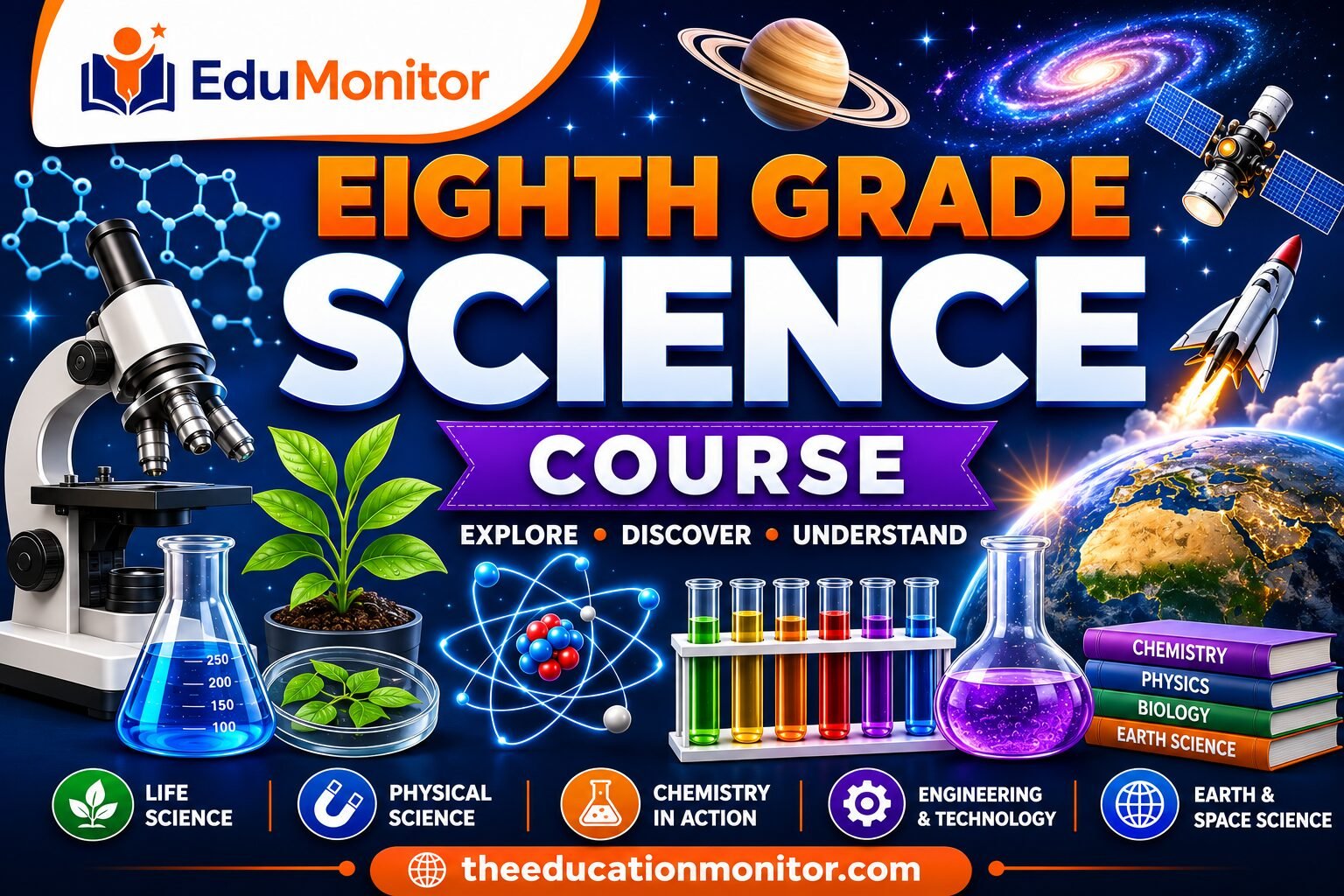
Course Name:
Eighth Grade Science
Course Information
Eighth Grade Science is a full‑semester course designed to strengthen scientific reasoning, deepen conceptual understanding, and prepare students for high‑school level science. Students will explore advanced physical, life, and Earth science concepts through investigation, modeling, engineering design, and real‑world problem‑solving.
Each unit emphasizes critical thinking, data interpretation, and scientific communication. Through digital labs, hands‑on projects, and inquiry‑based learning, students will build confidence applying science to everyday life, technology, and global challenges.
Course Delivery Method
Online
Contacting Your Instructor
You may contact your instructor through the Learndash messaging system. Technical support is available 24/7.
Course Objectives
After completing this course, students should be able to:
- Apply scientific inquiry to design, test, and refine investigations.
- Analyze matter, chemical reactions, and energy transfer at particle and system levels.
- Explain forces, motion, and interactions using Newtonian principles.
- Investigate waves, electromagnetic radiation, and technological applications.
- Describe Earth’s systems, climate processes, and geologic changes.
- Evaluate human impacts on Earth’s resources and environmental stability.
- Understand genetics, heredity, and biological evolution.
- Communicate scientific findings using graphs, models, and evidence‑based reasoning.
- Apply engineering design to solve scientific and environmental problems.
Textbook and Materials
No required textbook. All materials are provided digitally through EduMonitor. Optional: household items for experiments (listed per unit).
Technical Requirements
- Internet access (high speed recommended)
- Word processing software (Microsoft Word or Google Docs)
- Presentation software (PowerPoint or Google Slides)
- Adobe Reader
- Audio and video capabilities
- PDF app (free options available)
Technical Skill Requirements
Be comfortable with:
- Using a word processor
- Internet search engines and browsers
- Creating PDFs
- Uploading assignments and projects
Course Organization
This course consists of 15 units, each with 3–4 topics, one project per unit, one quiz per unit, a mid‑term exam, and a final exam.
Each unit includes:
- Introduction and Instructions
- Learning Objectives and Standards
- Learning Activities
- Assignments and Projects
Course Outline
| Unit | Topics | Project | Approx. Time |
|---|---|---|---|
| Unit 1: Scientific Inquiry & Experimental Design | Variables, Data Analysis, Scientific Claims | Design a Multi‑Variable Investigation | 2 weeks |
| Unit 2: Engineering & Technological Design | Problem Definition, Prototyping, Optimization | Build & Improve a Working Device | 2 weeks |
| Unit 3: Matter & Atomic Structure | Atoms, Elements, Isotopes | Create a 3D Atomic Model | 2 weeks |
| Unit 4: Chemical Reactions & Energy | Reaction Types, Energy Transfer, Conservation | Conduct a Safe Endothermic/Exothermic Lab | 2 weeks |
| Unit 5: Forces & Motion | Newton’s Laws, Momentum, Interactions | Build a Crash‑Test Safety Model | 2 weeks |
| Unit 6: Waves & Electromagnetic Radiation | Wave Properties, EM Spectrum, Applications | Build a Simple Wave Demonstration | 2 weeks |
| Unit 7: Energy Transfer & Systems | Thermal Energy, Conduction/Convection/Radiation | Create a Home Energy Efficiency Model | 2 weeks |
| Unit 8: Earth’s Systems & Climate | Weather vs. Climate, Greenhouse Effect | Model Climate Change Using Simulation Tools | 2 weeks |
| Unit 9: Geologic Processes & Earth History | Plate Movement, Rock Formation, Fossils | Build a Geological Timeline | 2 weeks |
| Unit 10: Human Impact on Earth | Resource Use, Pollution, Sustainability | Design a Community Sustainability Plan | 2 weeks |
| Unit 11: Cells & Biological Processes | Cell Structure, Cell Transport, Cell Energy | Build a Cell Structure Model | 2 weeks |
| Unit 12: Genetics & Heredity | DNA, Traits, Punnett Squares | Create a Family Trait Analysis Chart | 2 weeks |
| Unit 13: Evolution & Natural Selection | Adaptation, Fossil Evidence, Species Change | Model Natural Selection with Simulation | 2 weeks |
| Unit 14: Ecosystems & Interdependence | Food Webs, Energy Flow, Biodiversity | Build a Local Ecosystem Interaction Map | 2 weeks |
| Unit 15: Environmental Science & Global Challenges | Climate Solutions, Human Impact, Conservation | Create a Global Environmental Solutions Poster | 2 weeks |
| Mid‑Term Exam | Covers Units 1–7 | Mid‑Term Exam | 1 week |
| Final Exam/Project | Covers Units 1–15 | Final Exam + Capstone Project “Science in My World” | 3 weeks |
Course Credit
- 60% Coursework Average
- 40% Summative Assessment Average (Mid‑Term + Final Exam)
- Passing grade: 60% or higher
Grades: A: 90–100% B: 80–89% C: 70–79% D: 60–69% F: Below 60%
Coursework
Each unit includes a project that applies the concept to real life.
Examples:
- Unit 1: Design a multi‑variable experiment.
- Unit 4: Conduct a safe endothermic/exothermic reaction.
- Unit 6: Build a wave demonstration using string or slinky.
- Unit 12: Create a Punnett Square heredity chart.
- Unit 15: Develop a global environmental solutions poster.
Summative Assessments
- Mid‑Term Exam: Covers Units 1–7
- Final Exam: Covers Units 1–15
- Capstone Project: “Science in My World” — students choose one scientific concept and explain how it applies to everyday life.
Summative assessments may be proctored using Proctorio.
Course Completion
- Minimum completion time: 30 days
- Course expires six months after enrollment
Academic Integrity
Students must submit original work. Cheating, plagiarism, or falsifying data will result in disciplinary action according to EduMonitor’s K‑12 Student Handbook.
Student Expectations
Students must:
- Log in regularly
- Follow online netiquette
- Use respectful language
- Avoid spamming, hacking, or inappropriate content
- Maintain academic honesty
Communication
Instructor replies within 2 business days. Use Learndash Course Messages for all communication.
Submitting Assignments
Submit all assignments and projects through the Learndash Assignment Tool.
Technical Difficulties
If you experience issues, contact EduMonitor K‑12 Support. Always keep backup copies of your work.